
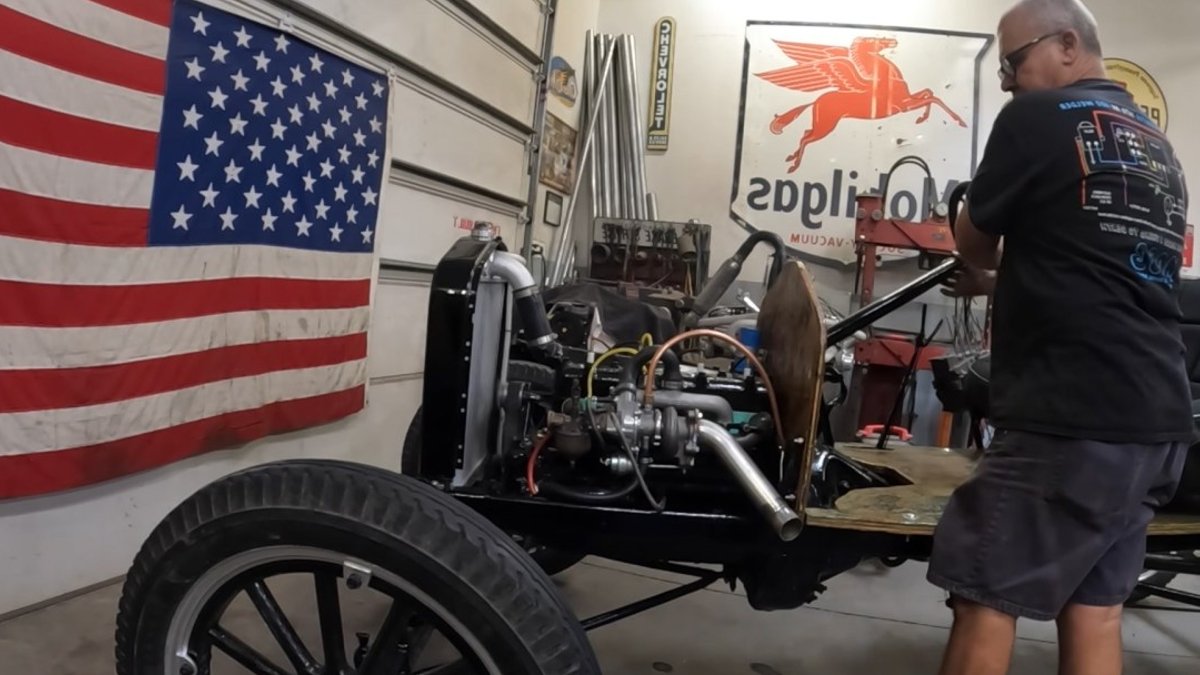
Turbochargers are often thought of as modern performance parts, but the technology predates the Ford Model T by a few years. Swiss engineer Alfred Buchi patented a design for exhaust-driven whirlers back in 1905, yet Henry Ford’s 1908 creation was never designed with forced induction in mind. That hasn’t stopped a modern hot-rodder from combining the century-old engine with a turbocharger off a compact Kubota tractor.
The Engineering Challenge
Merlin Johnson, who runs Merlin’s Old School Garage on YouTube, tackled the installation with a practical approach. He removed the original cast iron exhaust manifold, cut a hole, fabricated a flange, and bolted the turbo onto the engine. The physical fit was straightforward, but the lubrication system presented a significant hurdle.
Model T engines lack an oil pump. Instead, oil travels through a tube from the front of the engine to the transmission via a “dipper slinger” design. To prevent the turbo from seizing without this pressurized flow, Johnson had to tap into the system. He utilized centrifugal force from the flywheel to push oil through a copper tube that feeds the turbo, with a simple siphon drain returning the fluid to the engine.
This unconventional method required a careful understanding of the engine‘s primary lubrication path. The “dipper slinger” relies on the rotating crankshaft to physically scoop oil and splash it into the main bearings and camshaft. By redirecting a portion of this flow, Johnson ensured the turbocharger received the necessary lubrication to spin at high speeds without causing internal wear.
Related Post: Ford Recalls Broncos Due to Engine Fire Risk
Performance Gains
A quick startup in the shop showed no oil leaks from the homemade solution, and a test drive confirmed the modification works. Johnson’s initial neighborhood stroll demonstrated serious performance improvements. The top speed reached 28 mph, a five mph increase over the stock Model T.
While the turbo peaked at six pounds of boost, the test confirmed that a stock engine can handle at least that much pressure without failing. The Model T Ford response to forced induction proves the concept works, even if it isn’t the most efficient or economical method for modern restorations. It remains an interesting demonstration of how century-old hardware reacts to modern performance parts.
The first factory-turbocharged car wouldn’t appear until 1962 with the Oldsmobile Jetfire, meaning the Model T was never designed for high performance. That historical context makes the engineering hack even more notable, as it shows how far enthusiasts are willing to push vintage machinery. The system is functional and the results are tangible, though it likely won’t become a standard upgrade for the average restorer.
Historically, the sidevalve four-cylinder engine found in the Model T was originally intended for basic transportation, generating only 20 horsepower. Modern enthusiasts often look to modify these engines to increase their output, but the limitations of the stock internals make forced induction a risky proposition. Johnson’s success suggests that with adequate lubrication and proper tuning, the stock components can survive the added stress of forced induction.


