
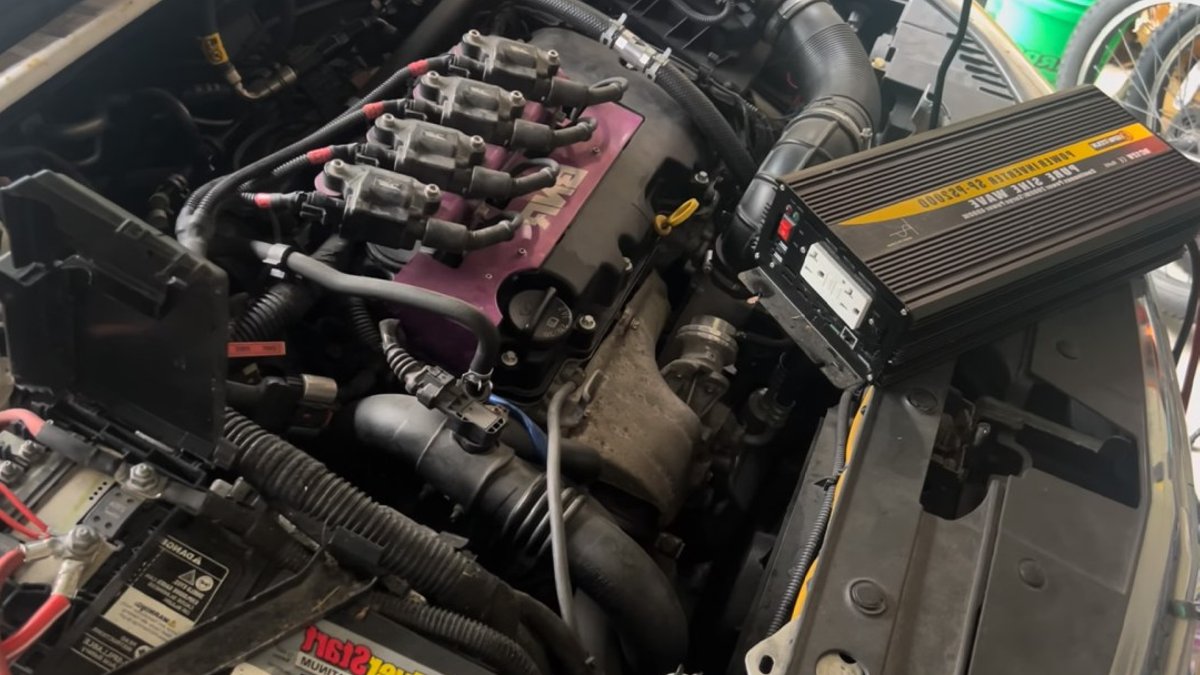
The idea of keeping the lights on during a power outage often leads people to buy a portable generator, but those are often sold out when storms hit. One Indiana resident demonstrated an alternative solution by using a 2012 Chevy Cruze as a stationary emergency power source. After a severe storm declared a disaster area in Valparaiso, the owner wired the car’s electrical system to run household appliances for more than five days, proving that a compact sedan can serve as a backup generator when needed.
How the Setup Works
The owner used the 1.4-liter turbo four-cylinder engine, which is standard in that model year. They upgraded the standard flooded lead-acid battery to an H7 AGM type and relied on the factory 130-amp alternator to charge the system. This power feeds into a 2,000-watt pure sine wave inverter capable of handling surges up to 4,000 watts. This setup allowed them to keep two full-size refrigerators, an upright freezer, a television, lighting, and office equipment running simultaneously.
Running the car continuously requires the engine to work harder than it does on the highway. The owner noted that the car’s idle speed automatically increased to 1,000 to 1,200 rpm under heavy loads to help spin the alternator. The electrical output remained steady, fluctuating between 12.2 and 12.8 volts most of the time. Even when the voltage dipped as low as 10.9 volts under a heavy draw, the devices appeared to function without damage. The owner uploaded the details of this experiment to their YouTube channel.
Related: Kia Niro’s base price now exceeds $30,000
Running Costs and Maintenance
Sustaining power for 120 hours consumed roughly 11 gallons of fuel. The owner calculated the rate of consumption at approximately .22 gallons per hour. While the car sat idling for days, the owner reported that the maintenance requirements were surprisingly low. They did not drive the vehicle but checked on it periodically to ensure it remained operational.
To ensure the long-term health of the engine after the five-day test, the owner sent a sample of the oil off for analysis. The results indicated no immediate negative effects from the continuous idling. It is worth noting that this specific configuration uses a vehicle engine, which offers a different set of trade-offs compared to a dedicated fuel generator. A traditional generator runs on gasoline or propane and is designed to be stationary, whereas a car must be started manually and monitored, making it less convenient for some users. However, for those who already own the vehicle, adding the necessary wiring and inverter provides a viable backup plan that avoids the hassle of finding a generator on store shelves.


