
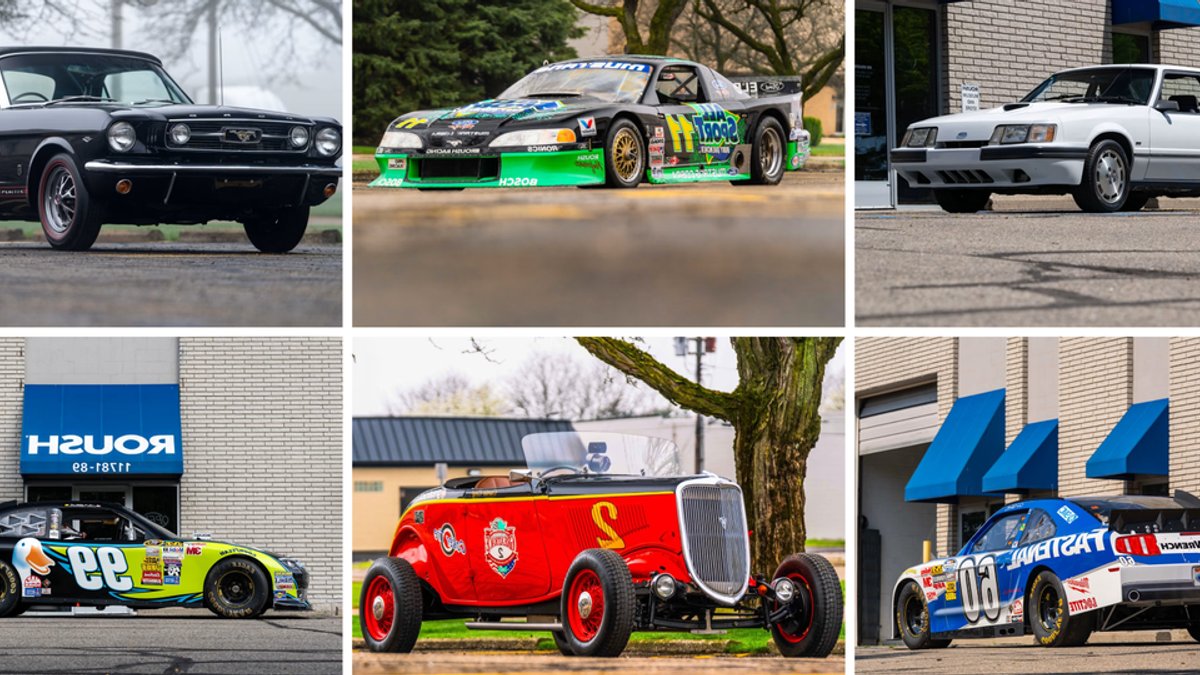
A rare lineup of Jack Roush’s personal cars—covering racing triumphs, engineering breakthroughs, and classic American hot rods—will be auctioned this month, offering a direct look at one of motorsport’s most defining careers. The selection features 12 vehicles, including a 1995 Ford Mustang Cobra that helped Paul Newman win the GTS-1 class at the 1995 Rolex 24 at Daytona, as well as a 2022 Mustang P-51B, a modern tribute to World War II fighter aircraft. While most cars trace Roush’s racing achievements, the 1934 Ford Roadster and 1966 Mustang GT Convertible highlight his deep appreciation for automotive heritage.
The star of the collection is the No. 70 “Nobody’s Fool” Mustang, the GTS-1 class winner at the 1995 Rolex 24 at Daytona. Newman drove the car alongside Tommy Kendall, Mark Martin, and Mike Brockman. Built on a NASCAR-style tube-frame chassis with a 750-horsepower Roush-prepared V8, it retains its original race-worn bodywork, now reunited for the auction. The car’s nameplate references Newman’s film Nobody’s Fool, and its victory coincided with his 70th birthday, blending Hollywood and motorsport in a unique way.
The 1997 Ford Mustang Cobra Trans-Am car is another highlight, driven by Kendall to 11 wins in a single season. That success secured both the driver’s championship and Roush Racing’s manufacturer title, solidifying the Mustang’s legacy in Trans-Am. The vehicle predates major rule changes, making it a snapshot of an era when Roush’s factory-supported Mustangs dominated the competition.
Mustangs That Redefined Ford’s Performance Legacy
Beyond racing, Roush’s collection includes two Mustangs that reshaped Ford’s performance image: the 2011 NASCAR Mustang, marking Ford’s return to the sport after years with the Fusion, and the 2005 Dodge Magnum R/T Extreme, a limited-edition show car demonstrating Roush’s engineering expertise beyond Ford products. The Magnum, an aggressively modified wagon, was built for SEMA and remains one of the most distinctive concept vehicles from Roush’s workshop.
The auction also features three NASCAR stock cars from Roush Fenway Racing’s peak years: a 2008 Fusion, a 2012 Fusion, and a 2004 Taurus, each linked to championships or near-misses. The 2004 Taurus played a role in Ford’s transition away from the model, while the 2012 Fusion appeared just before NASCAR’s Gen-6 car overhaul. Together, they illustrate Roush’s shift from the Taurus-dominated era to the Mustang’s modern resurgence.
What sets this collection apart is the consistent thread of innovation tying the vehicles together. From the 1966 Mustang GT, which sparked the pony-car trend, to the P-51B, a Mustang styled like a fighter jet, Roush’s choices reflect a man who viewed racing as both an art and a technical pursuit. The 1987 Mustang GT, with its aerodynamic updates and fuel-injected V8, anticipated the aftermarket performance movement Roush later helped shape.
Roush’s Final Racing Cars and Legacy Shift
The auction’s schedule is significant. Roush has spent decades defining Ford’s racing identity, yet many of these cars, some stored for years, are now being publicly displayed for the first time. The 2022 Mustang P-51B holds special meaning as Roush Performance’s final special-edition Mustang before focusing on electric and hybrid projects. Its inclusion suggests Roush may be transitioning leadership while keeping the cars as enduring symbols.
Bidding begins in early June, with the 1995 Cobra and 1997 Trans-Am Mustang expected to attract the highest offers. Early estimates for the Cobra exceed $1.2 million, though private collectors often exceed such figures for vehicles with this level of history. The Dodge Magnum, meanwhile, could sell for $300,000, $500,000 due to its status as a unique engineering project rather than a race car.
The 1966 Mustang GT Convertible, though older, holds its own value. As the defining car of the original pony-car era, it represents the muscle-car revolution Roush helped sustain. Its auction price will likely honor that legacy, even if it doesn’t reach the six-figure range of the newer racers.
Where the Cars May End Up
One uncertainty remains: whether the cars will stay in the U.S. or find international buyers. Roush’s collection blends American racing icons with global curiosities, and some vehicles, like the SVO—have strong overseas appeal. The P-51B, with its aviation-inspired design, may attract European or Asian collectors who value such hybrid performance-art pieces.


