
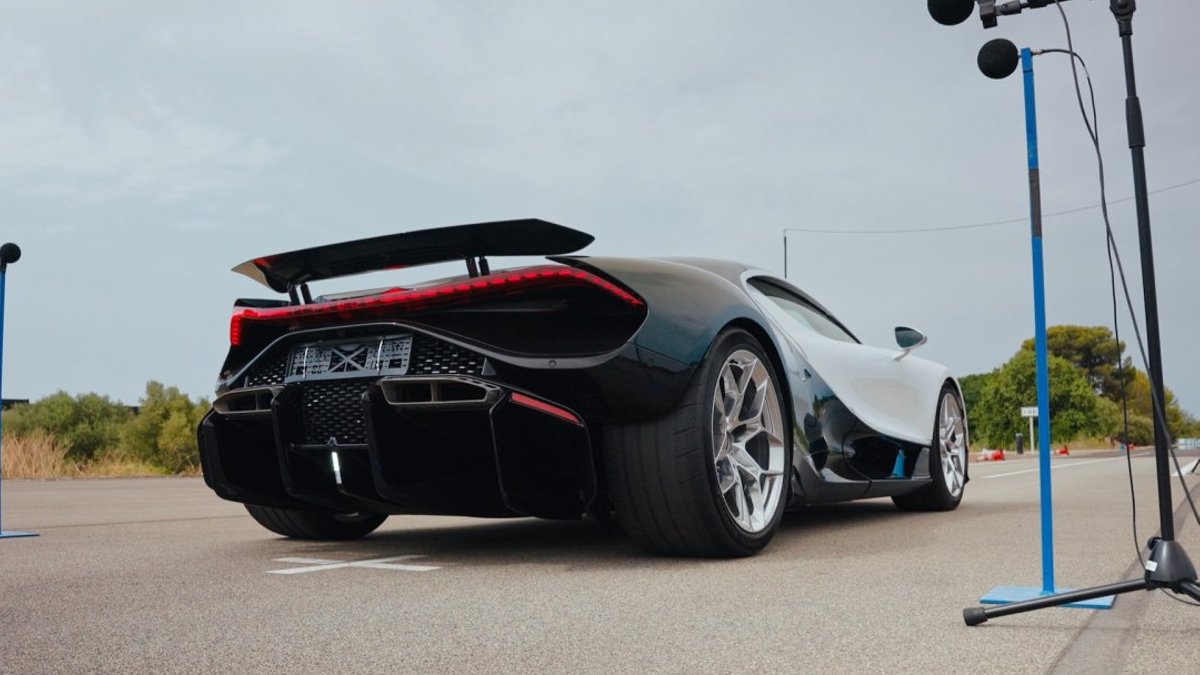
Bugatti invested thousands of engineering hours into crafting the exhaust tone for its Tourbillon, a naturally aspirated V16 engine capable of reaching 9,000 rpm. The precision was intentional: even elite vocalists require guidance, and a 1,800 horsepower hypercar demands exacting control. The 8.3-liter powerplant, developed by Cosworth, already delivers a commanding acoustic presence on its own. When paired with three electric motors, it generates 1,800 hp, enabling the Tourbillon to accelerate from 0-62 mph in 2 seconds and achieve a top speed of 276 mph.
However, merging its mechanical thunder with electric assistance presented a fresh engineering hurdle—one the architects of the Veyron and Chiron had not encountered before. Those prior models balanced performance with usability, reflecting Volkswagen’s heritage in mainstream production. The Tourbillon, by contrast, required a sound that was both thunderous and controlled. Engineers ensured it would be experienced with windows open—a departure from today’s aerodynamic obsession, and that its audio signature would feel natural, unburdened by artificial manipulation.
The Tourbillon’s exhaust design prioritizes tone over sheer volume. Unlike the crystalline clarity of earlier Bugatti engines, this V16 emits a gritty, unrefined growl that deepens rather than resonates. Romain Volatier, the automaker’s director of NVH (noise, vibration, and harshness) and acoustics, sought a “dirty and raw” character. This philosophy echoes Bugatti’s legacy: from the W16 quad-turbo units of recent models to the straight-eight engines of prewar racing cars, the brand has consistently championed a raw, unfiltered auditory experience.
Regulatory demands complicated the process. The Tourbillon had to comply with drive-by noise limits, capping emissions at 72 decibels—a total encompassing exhaust, tires, and airflow. Quieting those secondary noises allowed the exhaust to dominate, making its presence more pronounced. Production will remain exclusive, with only 250 units available. Deliveries commence later this year, though sightings will be scarce. The meticulous attention to its sound confirms Bugatti’s commitment to preserving what defines its vehicles, even as it incorporates modern electric technology.
The Tourbillon’s acoustic profile shows a broader industry movement: merging advanced engineering with traditional craftsmanship. Where past hybrid models sought invisible electric integration, Bugatti’s choice to highlight its mechanical identity proves some experiences resist digital refinement. The result is more than a vehicle, it’s a declaration that raw performance still holds meaning.
Volatier emphasized that the exhaust’s unpolished quality was no accident. This stance aligns with the brand’s historic preference for unfiltered expression, whether through the howling W16 of the Veyron or the straight-eight engines of classic prewar racing cars.
Legal restrictions required creative solutions. By minimizing background noise, tires, wind resistance, and auxiliary systems, the team ensured the exhaust could be louder while staying within noise regulations.
Limited to 250 units, the Tourbillon will test buyers’ patience. Early adopters, however, will experience an engine that refuses to be tamed by technology. The blend of electric assistance and mechanical fury creates a duality rare in modern hypercars.
Bugatti’s decision to prioritize auditory authenticity over silent efficiency marks a deliberate contrast to competitors. While others focus on seamless electric transitions, the Tourbillon proves some sounds cannot be erased, only refined.


