
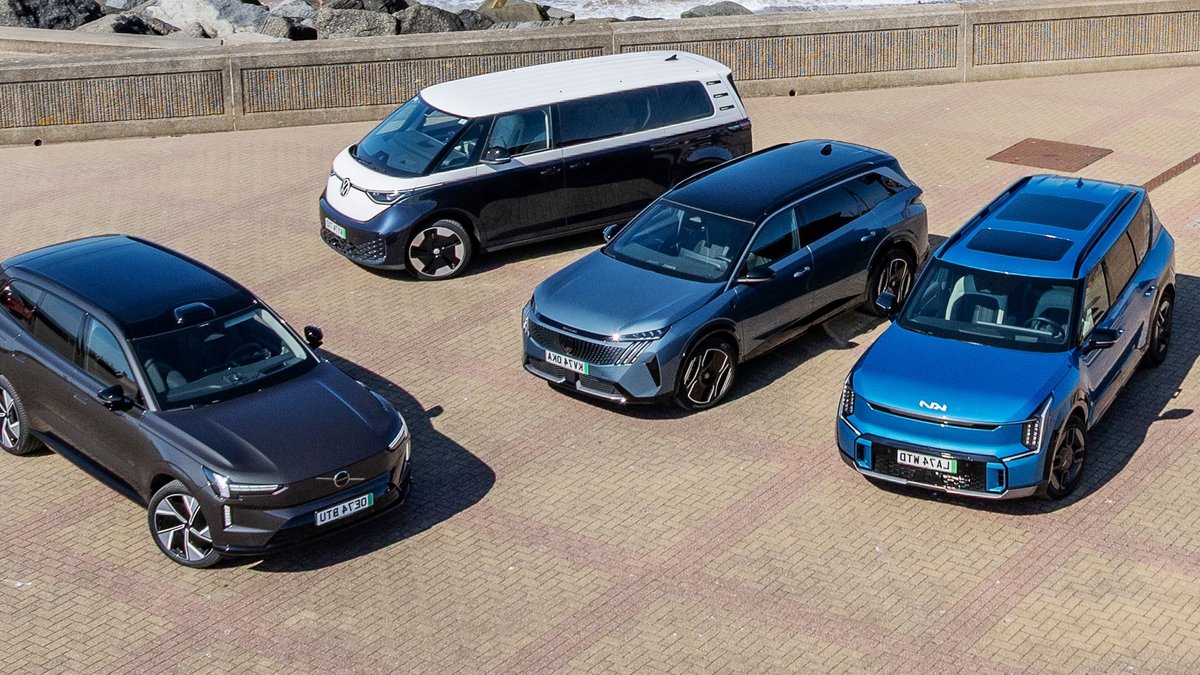
The electric seven-seater market has expanded significantly in recent years, providing families and businesses with more choices than ever before. By January 2026, buyers no longer face the limited options available just a few years ago. This growth aligns with broader industry trends, including stricter emissions regulations, advancements in battery technology, and declining costs. Some manufacturers, such as Vauxhall and Citroën, have quickly adapted by converting electric vans into seven-seat models, while others, including Hyundai and Volvo, are focusing on high-end electric SUVs equipped with luxury features and premium pricing.
The Hyundai Ioniq 9 remains the top all-rounder in the UK market. Its length exceeds five meters, and it features an 110.3kWh battery paired with a 3-meter wheelbase, creating a spacious interior that comfortably accommodates seven adults. While its efficiency does not meet the 385-mile WLTP claim—real-world range peaks around 300 miles—its 350kW DC fast-charging capability and refined interior justify its £65,000 starting price. Competitors like the Volvo EX90 offer greater luxury, but Hyundai provides better overall value.
The Kia EV9, built on the same platform, presents a more aggressive design and a 99.8kWh battery with a 349-mile WLTP range in its base configuration. A twin-motor version delivers 379 horsepower, enabling 0-62mph acceleration in 5.3 seconds. Charging remains equally efficient: a 10-80% charge takes 24 minutes, and even a 15-minute charging session adds 136 miles of range under optimal conditions. The driving experience remains polished, though less indulgent than the Ioniq 9. Priced at £65,000, it closely matches Hyundai’s offering, though its firmer ride may not suit every buyer.
Budget-friendly seven-seaters with government grants
For those prioritizing affordability, the Peugeot e-Rifter offers the best balance between cost and practicality. Starting at £31,600, after the UK electric car grant, it is one of the few models eligible for government subsidies. Sharing the same platform as the Citroën e-Berlingo and Vauxhall Combo-e, it provides 199 miles of range and a 30-minute 10-80% charge time. While it lacks the stylish appeal of an SUV, its sliding side doors and functional layout make it a practical choice for families or small businesses requiring seven seats without luxury features.
Premium electric SUVs balancing luxury and space
Mercedes-Benz’s EQB is a pure-electric version of the pragmatic but premium Mercedes GLB, which means it shares the same level of equipment and the same passenger-carrying ability. The rearmost seating row is relatively cramped, but there’s enough space everywhere else for most adults to get comfortable. If you need more room in the final row in as little road-space, take a look at one of the van-based alternatives instead; while there are plenty of other electric SUVs, only the Peugeot e-5008 also offers seven seats in such a compact package.
The EQB is available in front-wheel-drive 250+ 187bhp guise, or four-wheel-drive 222bhp 300 4Matic. The less powerful model is the version to go for if driving range is your main concern; while both versions now get a 70kWh battery pack, the extra driven axle puts a big dent in the official range, pulling it down from up to 324 miles in the EQB 250+ to 271 miles in the EQB 300. Still, either should be fine for regular family about town duties, and even with modest 100kW DC charging capability a 10-80 per cent refresh takes a tolerable 35 minutes.
Volkswagen’s ID.Buzz LWB introduces retro styling to the segment, featuring a boxy silhouette reminiscent of the classic Volkswagen Type 2. Its 86kWh battery and 293-mile WLTP range (real-world figures hover near 230 miles) pair with a 335bhp model that accelerates from 0-62mph in 6.4 seconds. The ride remains firm, and the fixed bench seat in the third row limits flexibility for families with young children.
Volvo’s tech-heavy EX90 vs. practical rivals
Volvo’s EX90 refines the seven-seat SUV formula with 374 miles of range and advanced safety technology, though its touchscreen-heavy interior reduces usability. Priced at £80,000 or more, it competes with the Ioniq 9 and EQV but falls short in software refinement.
Peugeot’s e-5008 offers a more accessible entry into the premium seven-seater market, starting just under £49,000. Its 97kWh Long Range battery provides up to 414 miles of range, though real-world performance varies due to efficiency fluctuations. The e-5008’s i-Cockpit design, featuring a digital dashboard and minimal physical controls, divides opinions, some owners adapt over time, while others prefer more tactile interfaces. Despite its compact size, the e-5008 delivers SUV-like styling and a comfortable ride, though the third row remains cramped for taller passengers.


