
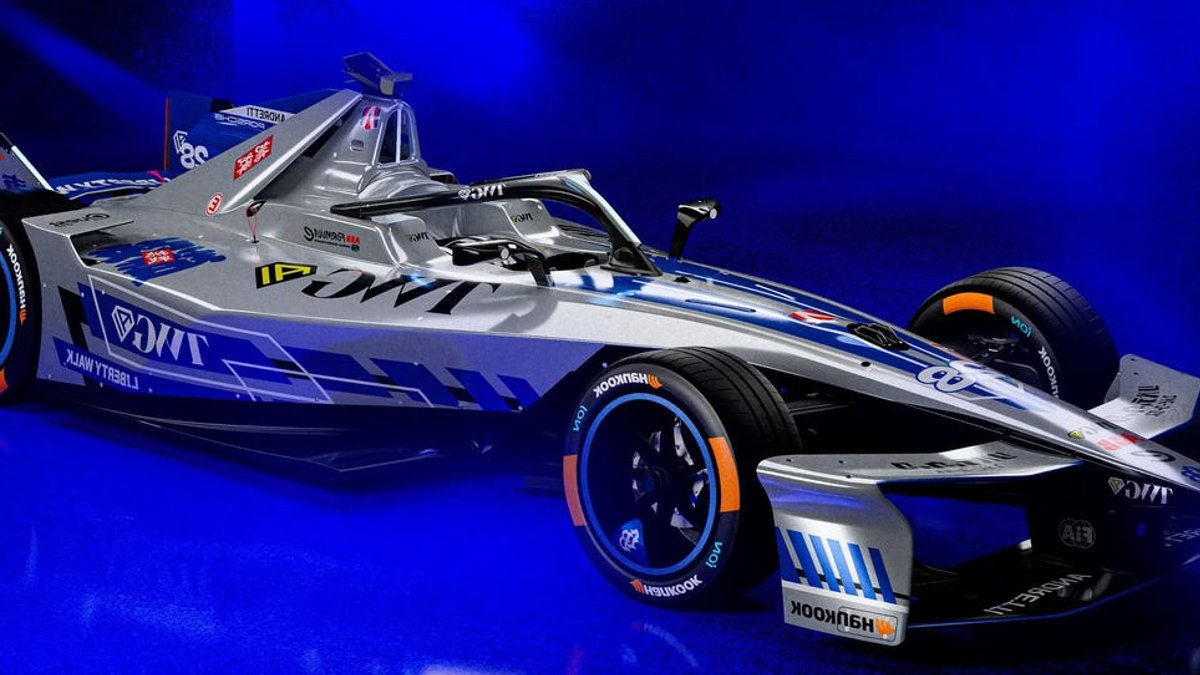
Andretti’s Formula E cars will race through Tokyo this weekend with a fresh look designed by a Japanese tuner known for turning supercars into low-slung, wide-body showpieces. The collaboration between Andretti Global and Liberty Walk marks a rare fusion of motorsport engineering and the tuner’s signature aesthetic, which has long prioritized visual impact over aerodynamic subtlety. Liberty Walk’s modifications often involve aggressive body kits that extend wheel arches to accommodate wider tires, lowering suspensions to near-scraping heights, and adding custom lighting or exhaust systems that transform factory models into head-turning statements. This approach has made the company a favorite among enthusiasts who value presence as much as performance, even if its builds occasionally sacrifice practicality for spectacle.
The two Gen3 electric racers now wear a chrome silver-and-blue livery created in partnership with Liberty Walk, a Nagoya-based company that has spent decades reimagining everything from Nissan Skylines to Lamborghini Miuras. The Gen3 cars, introduced in the 2022-23 season, represent the latest evolution in Formula E’s technology, featuring faster charging, lighter weight, and improved regenerative braking. Unlike Liberty Walk’s typical street builds, which often involve extensive physical modifications, the livery for Andretti’s racers is purely cosmetic—a layer of vinyl wrap that adheres to the car’s existing carbon-fiber bodywork. The silver base coat reflects the floodlights of the Tokyo circuit, while the blue accents pay homage to the tuner’s past projects, including the iconic R34 Skyline that inspired the design. The wrap’s high-gloss finish ensures the cars will stand out against the darker backdrop of the night race, where visibility is as much about aesthetics as it is about safety.
Old-school street vibes for a night race
The livery debuts at Formula E’s first night race in Japan, a setting that carries echoes of Tokyo’s street-racing heyday. Decades ago, grainy videos of modified Supras and Skylines hitting triple-digit speeds on Tokyo Bay roads became internet folklore. These clips, often filmed with handheld cameras and shared on early forums, captured a subculture that thrived in the pre-dawn hours, when traffic was light and police presence was minimal. The cars in those videos were typically equipped with aftermarket turbos, reinforced drivetrains, and stripped interiors to shave weight, all modifications aimed at maximizing speed on the narrow, winding roads near the bay. The drivers, often young and operating outside the law, treated the streets as an impromptu proving ground, pushing their machines to the limit in a high-stakes game of skill and nerve.
Strict enforcement has since curbed most of those runs, but the event this weekend offers a sanctioned version of the same energy. Modern Tokyo has implemented a network of speed cameras, license-plate recognition systems, and increased patrols to deter illegal street racing. The Formula E race, by contrast, channels that raw enthusiasm into a controlled environment, where the risks are managed and the spectacle is amplified by professional lighting, live broadcasts, and crowds of spectators. The circuit itself is a temporary layout, assembled on public roads near Tokyo’s waterfront, a location that once served as a hotspot for underground racing. The night race format adds an extra layer of drama, with the cars’ LED headlights cutting through the artificial darkness and the reflections of neon signs bouncing off their polished surfaces.
The design nods to the R34 Skyline driven by Paul Walker in 2 Fast 2 Furious, a choice that leans into nostalgia without sacrificing the futuristic edge of electric racing. The R34, released in 1999, became a global icon thanks to its role in the film, where it was depicted as a near-unbeatable machine capable of outrunning police and rival tuners alike. Liberty Walk’s interpretation of the car’s aesthetic strips away the heavy decals and aggressive spoilers often associated with its street builds, opting instead for a cleaner, more restrained look. The silver-and-blue color scheme evokes the metallic paints used on classic Japanese sports cars, while the chrome accents add a touch of retro-futurism that aligns with Formula E’s high-tech identity. The absence of the tuner’s usual white-and-red livery is intentional, a departure meant to signal that this collaboration is about more than just flash—it’s about bridging two distinct automotive cultures.
A track built for precision, not just speed
The Tokyo circuit is short, just 1.6 miles, but packed with 18 turns and lined with unforgiving Armco barriers. The layout, designed specifically for the Formula E race, winds through the streets of the Odaiba district, an area known for its futuristic architecture and waterfront views. The track’s tight corners and narrow straights demand a level of precision that differs from the high-speed, flowing layouts of traditional racing circuits. Drivers must handle a series of hairpins, chicanes, and elevation changes, all while managing energy deployment—a critical factor in electric racing, where battery life dictates strategy. The Armco barriers, made of corrugated steel, are designed to absorb impacts but can also punish even minor mistakes, sending cars ricocheting back into the racing line or causing damage that forces a pit stop.
Related: Ford Recalls Broncos Due to Engine Fire Risk
Drivers will need to balance aggression with control, especially under the glare of floodlights. Night racing introduces unique challenges, including reduced depth perception, shifting shadows, and the potential for glare off wet or reflective surfaces. The floodlights, positioned along the track’s edges, create pools of bright light that can obscure braking points or make it difficult to judge the apex of a corner. For Andretti’s drivers, who have spent the season adapting to the Gen3 car’s quirks, the Tokyo race will test their ability to maintain consistency in an environment where every lap presents new visual and mechanical demands. The team’s third-place standing in the championship suggests they’ve found a rhythm, but the night race adds an unpredictable variable that could either amplify their strengths or expose weaknesses.
Liberty Walk’s reputation for dramatic modifications doesn’t always translate to on-track performance, but the company’s builds rarely need to move to draw attention. The tuner’s street cars are often static displays at auto shows, where their exaggerated proportions and custom details make them instant conversation pieces. In motorsport, however, aesthetics must coexist with functionality, and the Andretti collaboration represents a rare instance where Liberty Walk’s design philosophy is applied to a machine built for competition. The Gen3 cars, with their carbon-fiber monocoques and advanced powertrains, are already optimized for speed, leaving little room for the kind of structural changes the tuner typically employs. Instead, the livery serves as a visual bridge between the tuner’s world and the high-stakes environment of Formula E, where every millisecond counts and every detail—down to the placement of a sponsor logo—can influence aerodynamics.
For Andretti, the challenge is different: the cars must look fast while actually being fast. The team’s engineers have spent months refining the Gen3’s setup, tweaking suspension geometry, brake balance, and energy recovery systems to suit different circuits. The Tokyo track, with its mix of slow and fast corners, will require a compromise between straight-line speed and mid-corner grip, a balance that could favor drivers with a smooth, calculated style over those who rely on brute force. The livery, while eye-catching, is ultimately secondary to performance, but it serves a strategic purpose. In a series still working to grow its audience, visual appeal can be a powerful tool for attracting new fans, particularly in a market like Japan, where car culture is deeply embedded in the national identity. A striking livery can turn casual viewers into engaged followers, especially when paired with a compelling race narrative.
The event arrives as Formula E works to expand its audience. The series, launched in 2014, has positioned itself as a sustainable alternative to traditional motorsport, emphasizing innovation, urban accessibility, and a reduced carbon footprint. Night races, which are still relatively rare in the sport, offer a way to differentiate Formula E from its competitors, creating a spectacle that blends technology with the raw energy of street racing. Tokyo, a city synonymous with automotive passion, is an ideal setting for this experiment. The race’s timing—starting at dusk and running into the night—aligns with the city’s nocturnal culture, where neon-lit streets and late-night gatherings are part of the rhythm of life. For local fans, the event is an opportunity to see world-class racing on familiar roads, while for international viewers, it’s a chance to experience a side of Tokyo that extends beyond its reputation as a tech and fashion hub.
The livery ensures the cars won’t be overlooked, but the race itself will determine whether the collaboration leaves a lasting impression. Andretti’s drivers will take to the track Saturday evening, local time, with the race set to start at dusk. The timing is symbolic: as the sun sets over Tokyo Bay, the floodlights will come to life, illuminating the silver-and-blue cars as they handle a circuit that pays homage to the city’s automotive past while pointing toward its electric future.


