
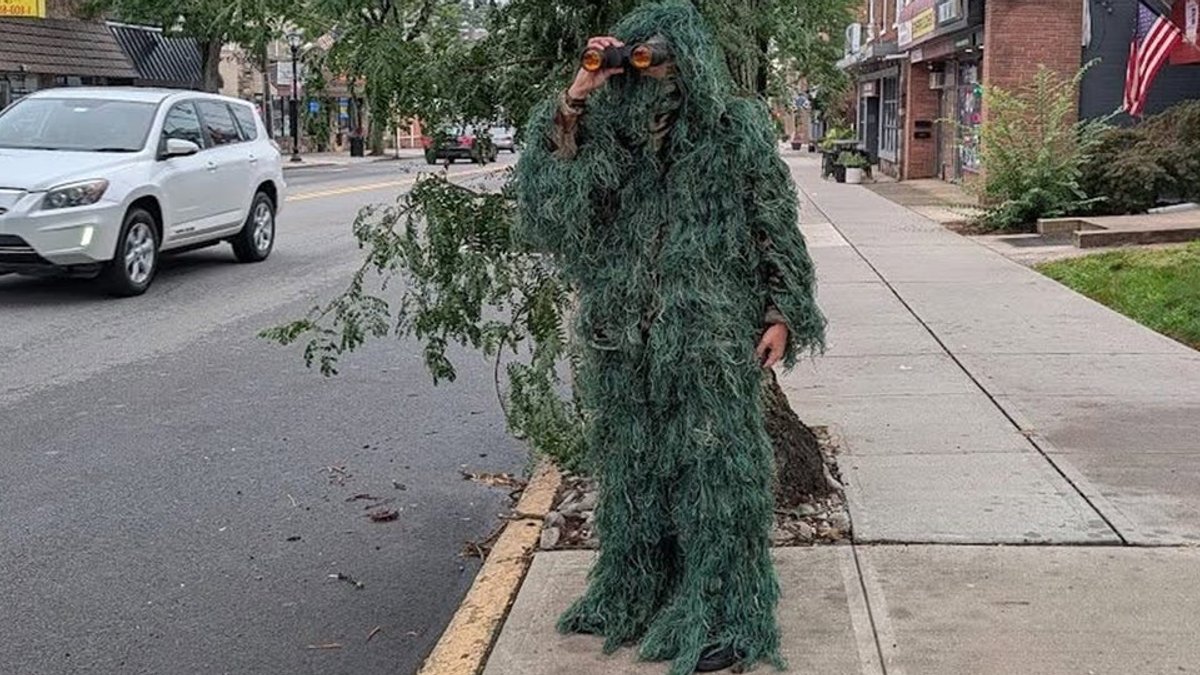
An unassuming shrub on a New Jersey street corner recently issued 74 traffic citations in six hours. It wasn’t a plant—it was a police officer concealed within a ghillie-style suit designed to mimic roadside bushes. The operation, conducted by the Dunellen Police Department, took place along the 100 block of North Washington Avenue, a busy downtown corridor with heavy vehicle and pedestrian traffic. The location was selected specifically because of the number of people walking through the area and the importance of keeping drivers focused on the road.
The Dunellen Police Department ran an undercover operation last week, employing ghillie-style suits to blend into the roadside environment. Officers stationed themselves near curbs, using the camouflage to observe traffic without drawing attention. The goal was to catch drivers interacting with their phones without realizing they were under surveillance.
Seventy-four citations in one shift
The department posted photos on Facebook documenting the operation. One officer wore a plain T-shirt with the phrase “Not a Cop” printed across the front. According to the post, the operation lasted six hours, during which officers in ghillie suits monitored traffic for violations. Each time a driver was observed holding or interacting with a phone, the undercover officer radioed a marked patrol car positioned further down the street. The patrol vehicle then conducted the traffic stop, issuing citations for violations of New Jersey’s handheld cell phone law.
The department chose the location deliberately. North Washington Avenue is a busy commercial and residential corridor. Distracted driving in such an environment increases the risk of collisions. While no crashes or injuries were reported during the operation, the volume of citations suggests that distracted driving is a persistent hazard in the community.
Related: YouTuber crashes Cybertruck into F-150 at 111 mph
Distracted driving still a leading cause of crashes
Nationwide, distracted driving caused 315,167 injuries and 3,208 deaths in 2024, according to the National Highway Traffic Safety Administration. The data shows a broader public safety crisis, as even a momentary lapse in attention can have catastrophic consequences. New Jersey’s enforcement of its handheld device law reflects a growing recognition that traditional methods may not be sufficient to curb the behavior.
The psychological impact of the shrub operation may prove as significant as the citations themselves. Drivers who passed the disguised officers likely assumed they were merely glancing at ordinary landscaping, only to later realize they had been under observation. This element of surprise could lead to lasting behavioral changes, as motorists become more cautious about phone use in areas where enforcement might be present but not immediately visible. The tactic also highlights the adaptability of law enforcement in addressing public safety challenges, particularly as distracted driving incidents continue to rise.
Whether the shrub strategy becomes a regular tactic isn’t clear. The Dunellen Police Department hasn’t indicated if it plans to repeat the operation, though the viral nature of the photos and the volume of citations have already sparked interest beyond the town’s borders. Other police departments have reached out to Dunellen, requesting details on logistics and coordination between undercover and marked units. Some agencies have inquired about the legal considerations of such operations, though legal experts have noted that as long as officers are merely observing violations rather than inducing them, the tactic remains within the bounds of lawful enforcement.
For now, the message is simple: the next time you glance at your phone behind the wheel, the bush on the corner might be watching. The operation serves as a reminder that enforcement can take unexpected forms, and that complacency behind the wheel carries real risks. Pedestrians and other drivers rely on the assumption that those operating vehicles are fully attentive to their surroundings. When that assumption is violated, the consequences can be irreversible.


