
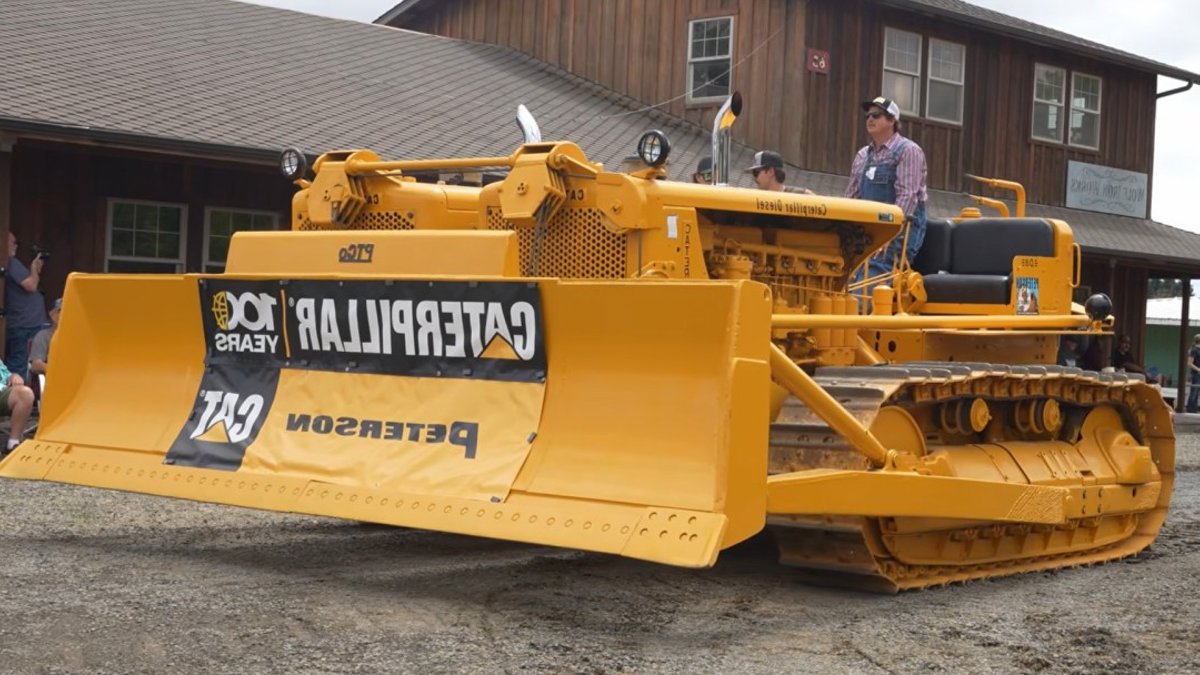
The machine resembles a bulldozer that kept expanding. A restored double-wide Caterpillar D8, designed to move twice the earth, now stands in Oregon—driven by two inline-six diesel engines connected side by side.
The original monsters didn’t survive
Caterpillar launched the D8 in 1935. By the 1950s, Peterson Tractor Company, a West Coast dealer, needed greater capacity. Construction crews were leveling San Francisco’s hills, and standard dozers fell short. Peterson’s solution involved welding two D8s together, producing three “Twin Dozers” equipped with paired D13000 engines. Each engine displaced 1,246 cubic inches.
The combined output reached 200 horsepower, an enormous figure for the era. The larger D9 model wouldn’t debut for years. Yet none of the original Twin Dozers remained intact. Decades of demanding work led to their scrapping or disappearance.
A fourth Twin Dozer, built for an anniversary
Peterson CAT marked its 80th anniversary in 2016 by constructing a new version. The rebuilt dozer replicates the original design: two mechanically linked D13000 engines, each started by a gasoline pony motor. A lever disengages the inboard steering clutches, allowing operators to control the machine from either side for improved blade visibility.
Related: Genesis Unveils Futuristic GV90 Luxury SUV
The dozer spent eight years outdoors at Peterson’s Hillsboro facility. Exposure to sun and rain caused paint to fade and water to infiltrate an engine. Restoration became necessary.
Nate Degerstedt, who oversaw the project, explained the process in a YouTube video by SEFILMS. Collectors Ed Akin and Glen Ghilotti collaborated with the Doyle family, current owners of Peterson CAT, to locate parts. The outcome is serial number 004, a working replica of the original machines.
Purpose beyond raw power
The Twin Dozer addressed a practical challenge: moving earth on steep, irregular terrain. Contemporary dozers manage this with advanced controls and single, more efficient engines. In the 1950s, however, raw power provided the only answer.
The restored machine now functions as a mobile exhibit. It demonstrates how innovation often arises from immediate needs rather than careful planning.


